Posted by FundForum on 23 March 2026
AI in financial services: Where value is actually emerging

Every financial services professionals you speak to will agree that AI will transform the industry, but how that transformation translates into practical, day-to-day implementation remains far less clear.

As a fund researcher, I have the privilege of visiting asset managers to discuss their AI strategies, while also leading our own implementation efforts at Morningstar. That gives me a useful vantage point – not just on the ambition, but on the reality of where the industry stands today.
What becomes clear very quickly is that the narrative is running ahead of the execution. Every firm I have spoken to agrees that AI matters, but they are trying to work out where it genuinely adds value and how to embed it into day-to-day processes.
The winners in AI will not simply be those experimenting with the technology, but those able to integrate it into repeatable, revenue-generating workflows.
From experimentation to application
Over the past two years, much of the industry has been in an exploratory phase – piloting tools, testing use cases, and assessing capabilities. That phase is now ending. What we are seeing instead is a shift towards targeted deployment in areas where the return on investment is clearer and more immediate.
Three areas stand out.
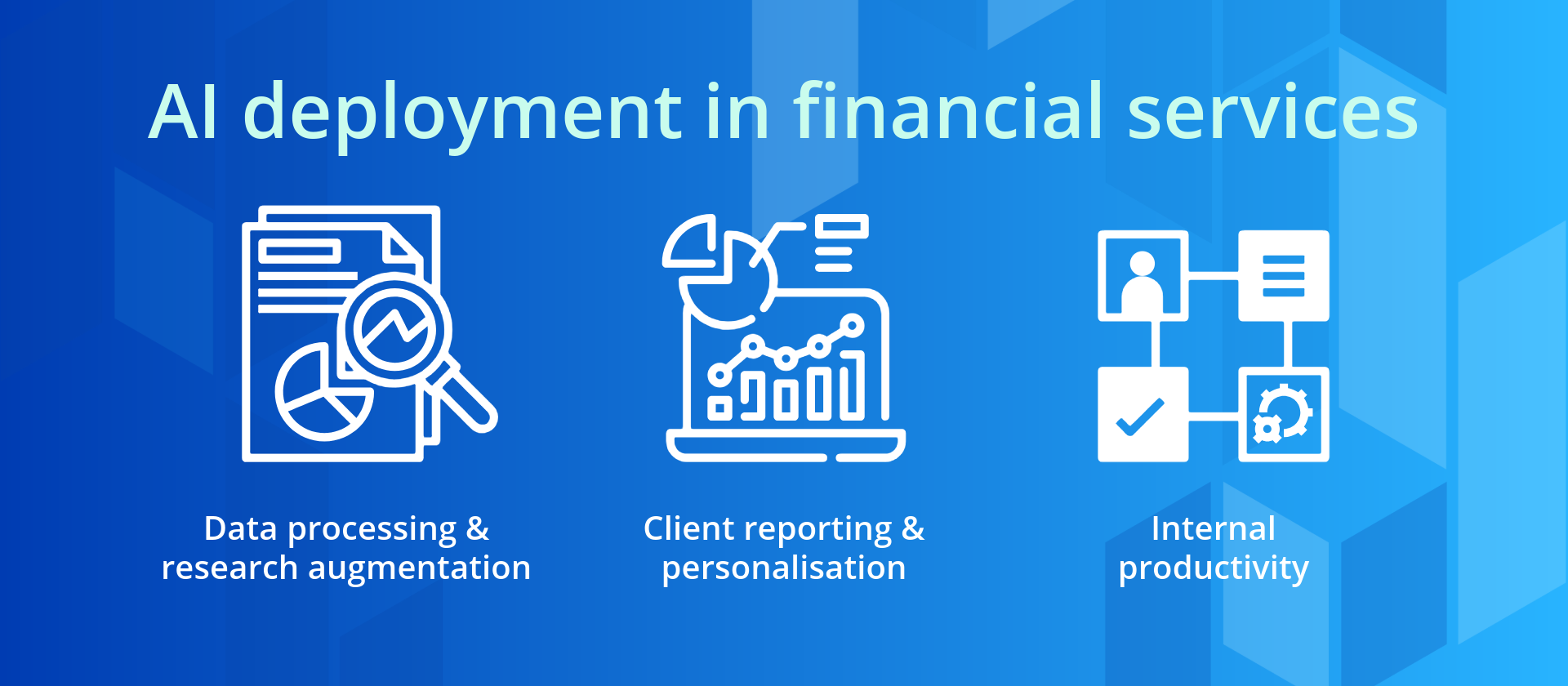
Data processing and research augmentation
AI is proving highly effective at structuring and interpreting large, unstructured datasets – earnings calls, filings, news flow – reducing the time analysts spend on manual tasks and allowing them to focus on higher-value judgement. The applications in fund research are clearer than most, with fresh insights and efficiencies to be wrung from absorbing and analysing huge swaths of unstructured data.
Client reporting and personalisation
Firms are using AI to generate more tailored outputs at scale, improving client engagement without materially increasing operational cost.
Internal productivity
From code generation to workflow automation, AI is quietly improving efficiency across operations, even where it is not directly visible to end clients.
In each case, the common thread is not disruption, but augmentation – enhancing existing processes rather than replacing them outright. On the research team, some big data projects which once would have required support from other teams can now be undertaken directly, with far less bureaucratic friction.
AI alpha?
There has been much discussion of “AI alpha” in fund management, but in our conversations with managers, AI is being deployed as a set of quantitative tools within the broader investment toolkit. Portfolio managers retain ultimate responsibility for trading decisions, rather than delegating them to standalone models. In practice, the most compelling applications for portfolio managers today remain in the first and third areas outlined above.
The real constraint are not models, but infrastructure
Despite rapid progress, adoption is not frictionless. The limiting factor is rarely the sophistication of AI models themselves, but the infrastructure around them.
The most immediate issue is data quality.
Financial institutions typically operate across fragmented data environments, with inconsistent schemas and varying levels of completeness. Feeding this directly into AI systems creates significant downstream issues – requiring extensive normalisation and validation, and often producing inconsistent outputs.
Put simply, AI systems amplify the strengths and weaknesses of the data they are built on. Firms with clean, well-structured datasets are able to move quickly. Those without are forced into costly and time-consuming preparation work before they can extract meaningful value.
Trust is becoming the differentiator
As AI moves into production environments, another constraint is emerging: trust.
Early-stage experimentation tolerated a degree of opacity. That is no longer the case. In regulated industries, outputs must be explainable, defensible, and auditable.
This creates a tension. Many of the most powerful models are inherently complex, yet their outputs must be understood not just by engineers, but by portfolio managers, clients, and regulators.
The implication is clear: black-box approaches will struggle to scale in financial services. Firms that can combine performance with transparency – through robust data lineage, clear methodologies, and explainable outputs – will have a significant advantage.
The scaling challenge
Perhaps the most underestimated challenge is moving from isolated use cases to enterprise-wide deployment.
Many firms today are running multiple AI initiatives in parallel – across research, operations, and client interfaces – but these are often siloed. The result is duplication, inconsistency, and increased complexity for engineering teams.
Without this, AI risks remaining a collection of point solutions rather than a cohesive capability.
A pragmatic outlook
AI will undoubtedly reshape financial services, but the trajectory is likely to be incremental rather than transformative in the near term.
The greatest value today is being realised in areas that are, data-intensive, repetitive and scalable.
The firms seeing the most success are not necessarily those with the most advanced models, but those with the strongest foundations – data quality, governance, and integration.
Join Kenneth Lamont and 1500+ senior professionals at FundForum, where the future of wealth is defined.