Why Fibre Adoption Is Europe’s Next Big Challenge

Europe's fiber market has entered a transitional phase, moving from aggressive network expansion toward market maturity. While deployment continues across the continent, the industry now confronts a challenge: converting infrastructure investment into sustainable revenue through effective subscriber acquisition.
Fiber deployment status across Europe
Fiber coverage continues to expand across Europe, though deployment is slowing as markets mature. Coverage continues to deepen throughout the region, extending into previously underserved communities and rural areas. This infrastructure expansion is translating into market share gains, with Omdia's World Broadband Information Series (WBIS) data projecting fiber technology share to reach 60% by end-2026 (see Figure 1).
Figure 1: Europe, total broadband subscriptions and fiber share of the total, 2023-26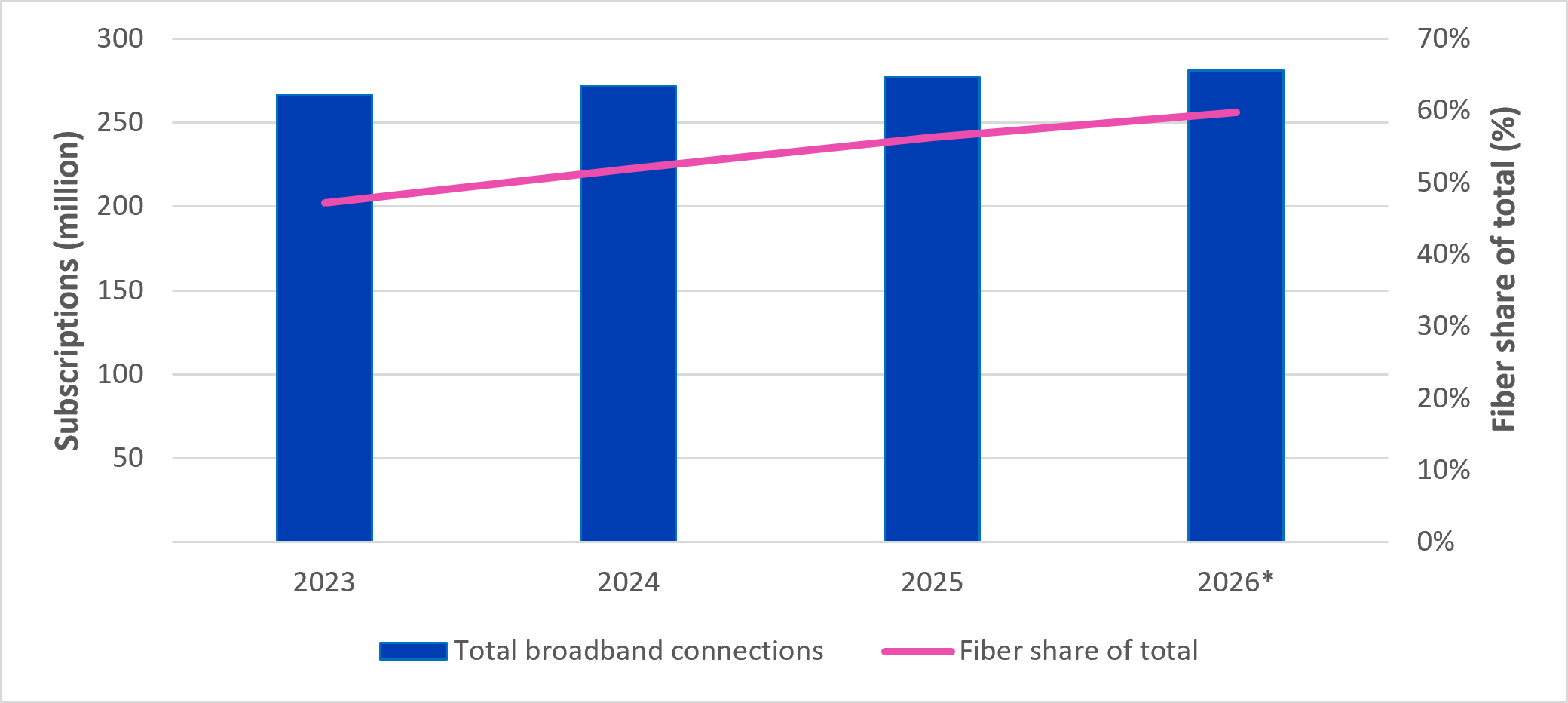
Note: *2026 is forecast data
Source: Omdia’s World Broadband Information Series (WBIS)
Key drivers of fiber deployment
According to Omdia’s The State of Global Fiber Deployments report, several factors continue to drive fiber deployment across Europe.
• Copper switch-off initiatives are accelerating migration to fiber infrastructure, with incumbent operators decommissioning legacy networks and transitioning customers to next-generation technology.
• Regulatory frameworks provide essential support for continued expansion. The Digital Decade Strategy establishes connectivity targets for the region, while the forthcoming Digital Networks Act is expected to streamline deployment processes and reduce administrative barriers. These policy initiatives provide investor confidence and regulatory certainty necessary for sustained infrastructure investment.
• Public funding has proven particularly effective in extending coverage beyond commercially viable areas. EU-level and national funding programs have significantly accelerated deployment in rural and underserved regions where private investment alone would be insufficient.
Despite the progress, fiber coverage across Europe varies considerably, ranging from near-universal availability in leading markets to developing networks in others. This disparity reflects differences in market maturity, regulatory pressure, investment appetite, competitive intensity, and geographic challenges.
Investment environment and market structure
Europe's fiber deployment success reflects a robust investment ecosystem. Fiber infrastructure has established itself as a long-term asset class, attracting private equity, pension funds, and institutional capital. Investors view fiber networks as infrastructure assets with predictable cash flows and extended useful lives, making them attractive within diversified portfolios.
The region's pro-competitive market structures have accelerated deployment beyond traditional incumbent capacity. Alternative operators (altnets), open-access networks, and wholesale-focused business models have expanded deployment activity substantially. This competitive landscape has enabled infrastructure sharing arrangements, strategic overbuild in high-value areas, and rapid expansion into rural regions, complemented by targeted public subsidies.
The coverage-to-adoption gap
Infrastructure coverage does not automatically translate to commercial success. A significant gap exists between homes passed by fiber networks and actual subscriber adoption. This disparity represents lost revenue and affects the return on investment needed to support continued infrastructure funding.
Adoption rates vary substantially across European markets. Some countries have achieved high conversion rates, with fiber footprints approaching full penetration and generating strong returns on infrastructure investment. Other markets experience considerably lower adoption despite growing infrastructure availability, creating financial pressure on operators who invested heavily in deployment.
For example, according to Omdia’s World Broadband Information Series (WBIS) and Fiber Homes Passed Tracker – 1Q26 data, Spain and France represent early movers that deployed fiber aggressively, achieving fiber uptake rates close to 90%, while others, like Germany and the United Kingdom, are currently experiencing rapid deployment growth as they address coverage gaps (see Figure 2).
Figure 2: France: fiber homes passed, fiber subscriptions and fiber share of the total, 2023-25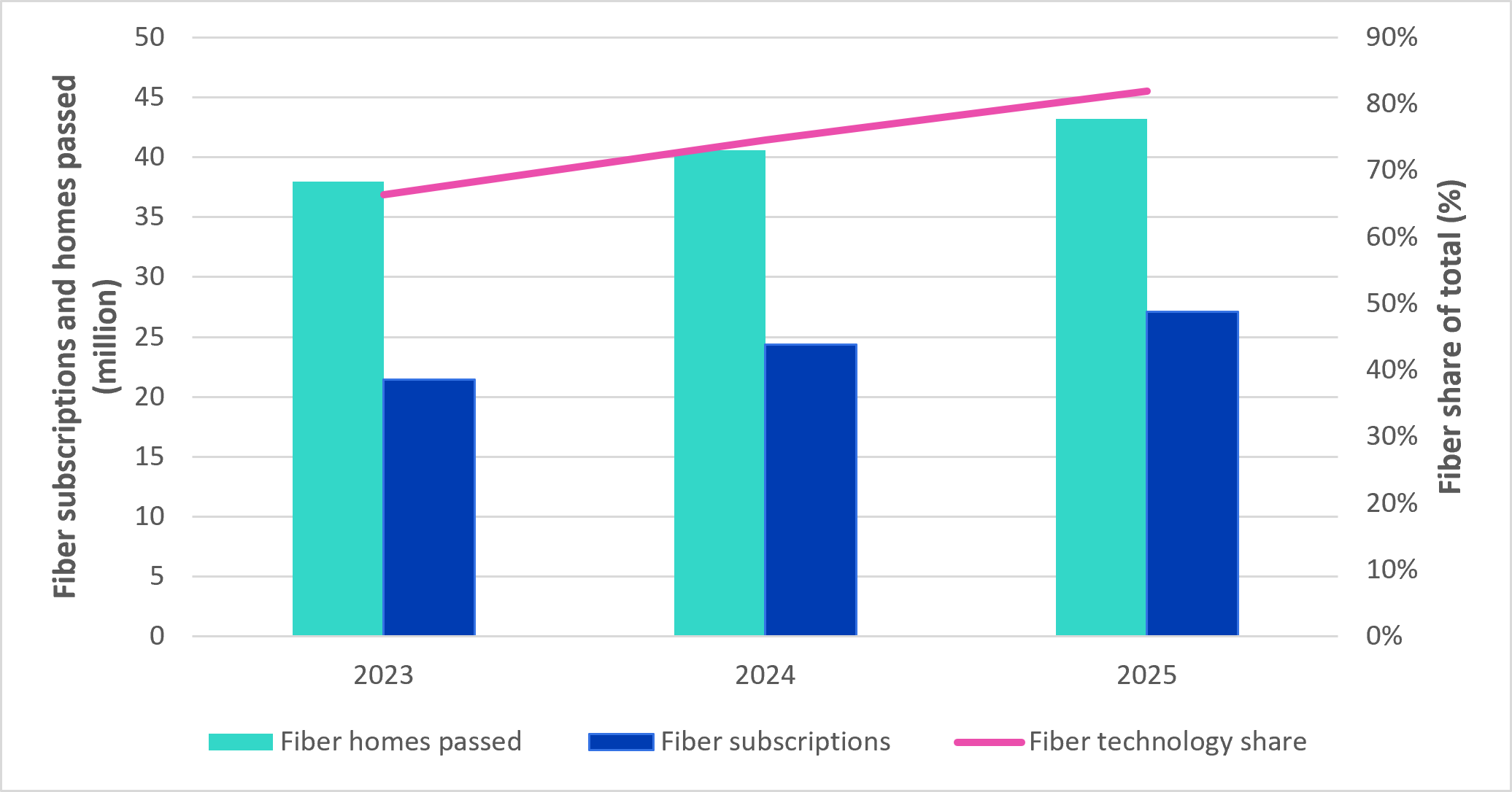
Source: Omdia’s World Broadband Information Series (WBIS); Omdia’s Fiber Homes Passed Tracker – 1Q26; ARCEP
Approaches to subscriber conversion
As deployment slows in mature markets, operators are focusing more on attracting and converting subscribers. Regulatory initiatives that make it easier to switch providers help consumers move to fiber services. Simpler switching processes improve conversion rates by reducing concerns about service disruptions.
Pricing strategies and value propositions remain fundamental, particularly in markets with established legacy infrastructure. Operators must clearly explain fiber's technical advantages: faster speeds, better reliability, equal upload and download capacity, and long-term technology value, while creating offers that motivate consumers to switch. Targeted communication highlighting practical applications, including video streaming quality, remote work reliability, smart home support, and gaming performance, proves more effective than technical specifications alone.
Partnership strategies with property developers, housing associations, and local authorities create opportunities for bulk conversions and pre-installation in new developments.
Conclusion
Europe's substantial investment in fiber infrastructure has established a foundation for advanced digital connectivity. While deployment continues in underserved areas, the industry's commercial success increasingly depends on effective subscriber conversion and network utilization. With the infrastructure foundation largely established, the focus now shifts to maximizing its utilization and commercial value.
Explore these dynamics at Network X 2026: The strategic implications of these market dynamics, including the evolving debate around technology agnosticism and converged network approaches, will be examined at Network X 2026 in the fireside chat: "Technology Agnosticism: Are Converged Networks the Future of Connectivity?" featuring Orange. View the session and register to join the conversation.
Understand the broader context: Join Omdia's telecoms research leaders at Network X 2026's Breakfast Briefing for rapid-fire perspectives on the forces shaping 2027, including network economics, new revenue opportunities, and regulatory resilience. Omdia Research VP Dr Ronan de Renesse will set the scene with Omdia's Forces Shaping 2027, followed by five analyst perspectives in five minutes. Register for the 40-minute executive briefing to understand where fibre investment fits within the industry's defining shifts.
About the Author
Diana Gorelik is a principal analyst leading European market research for Omdia’s Service Provider EMEA Markets Intelligence Service team.
Read more about fiber deployment trends in Omdia's The State of Global Fiber Deployments report and Fiber Homes Passed Tracker – 1Q26.