Posted by Matt Swenson on 19 May 2026
Spotlight on Stuart Butler, President, Visit Myrtle Beach
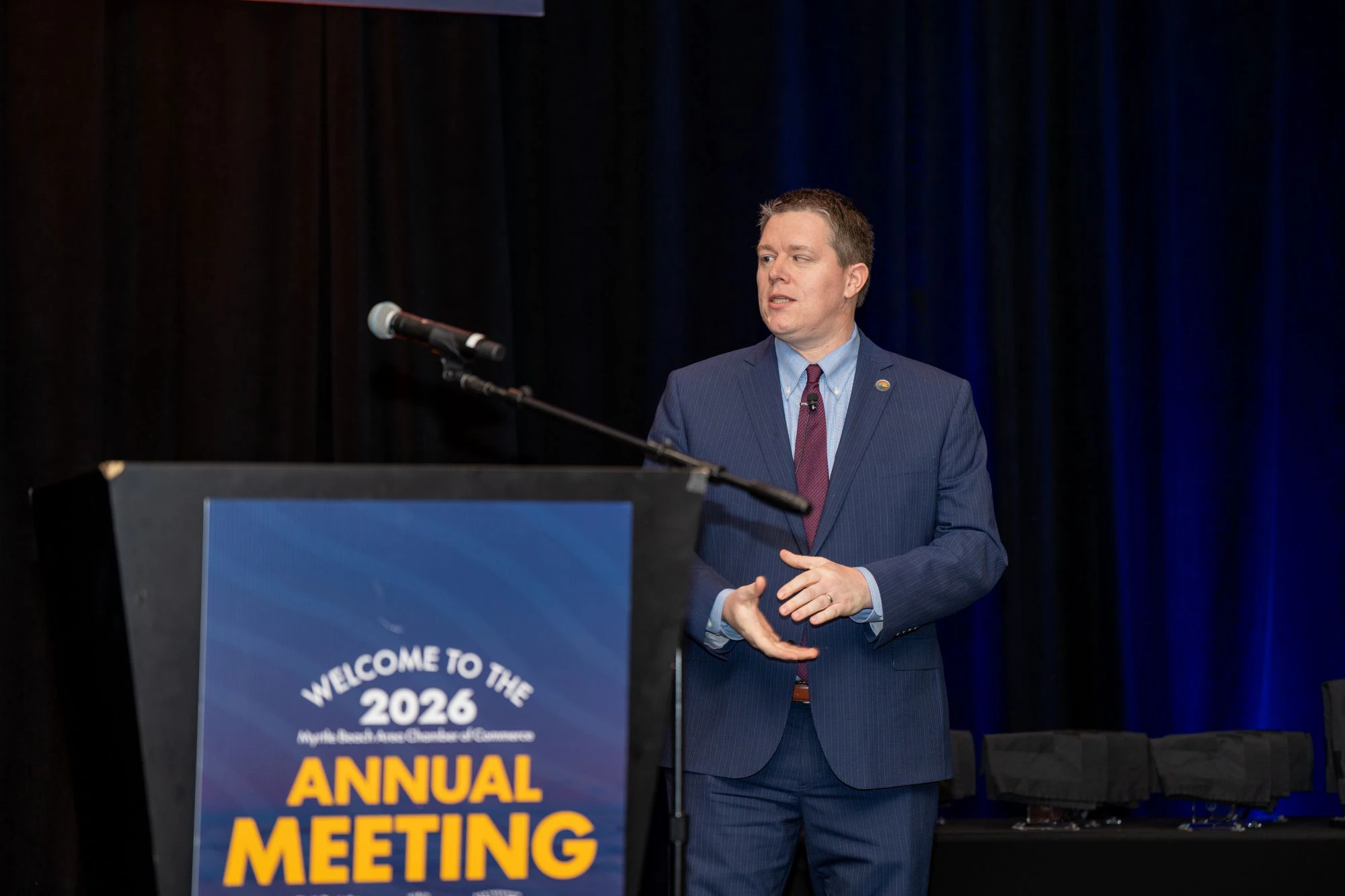
Stuart Butler, president of Visit Myrtle Beach, is among the most qualified people to tell you that destination marketing is not rocket science. But it’s not that far off either.
Butler’s unusual path to prominence at one of the country’s premier beach destinations began in his home country of England, where he studied Physics with Space Science and Systems, followed by postgraduate work in Computer Science. “I moved to America with a suitcase, an education, and probably more optimism than common sense and ended up getting a job with a software and web development company working in hospitality,” Butler recalled.
Little did he know that background is ideal in this digital era of destination marketing, in which traditional playbooks must be scrapped to reach would-be visitors. Butler has acted more like the head of a content studio than a traditional marketing officer, helping alter preconceptions about Myrtle Beach and establishing the DMO as a forerunner in the digital tourism space.
Successful projects that the DMO has developed include:
- Traveling the Spectrum, a six-part series follows three families living with autism as they travel to the beach. The show premiered on Peacock and earned an Emmy nomination.
- Chef Swap at The Beach on the Cooking Channel, featuring local Chef Mason Zeglen guiding two Myrtle Beach chefs as they work in each other’s kitchens during an episode.
- Charlie’s Place, a collaborative podcast series with Atlas Obscura that explored an important chapter of Myrtle Beach history and earned multiple international podcast awards.
- A partnership with Matador Network on a month-long creator residency embedded in Myrtle Beach.
Most recently, the DMO created Mitarry Best, an intentionally bizarre AI-generated Reddit activation built around exaggerated Myrtle Beach imagery. “It was humorous, weird, self-aware, and designed specifically for internet culture rather than traditional tourism audiences,” Butler said.
“Sometimes being scrappy means having the courage to test things before the playbook exists.”
The efforts have been noticed. Butler was named Content Marketer of the Year by the Content Marketing Institute and Tourism Partner of the Year by the Myrtle Beach Area Hospitality Association, and Visit Myrtle Beach’s website earned an eTSY at the Tourism Summit.
Who knew being a data specialist would work so well in the decidedly human hospitality industry?
“What I love about hospitality is that it sits right at the intersection of technology, psychology, storytelling, economics, and human experience,” Butler said. “It is one of the few industries where both data and emotion matter equally. You can build the most sophisticated marketing systems in the world, but if you fail to understand people, hospitality breaks down pretty quickly.”
Inspired Insights spoke to Butler about content creation, integrating new technology, and redefining Myrtle Beach.
Myrtle Beach is a beach favorite for so many. Walk us through marketing a well-known destination.
Out of extensive research with visitors, residents, stakeholders, and non-visitors, we realized Myrtle Beach had incredible awareness, but people often viewed us through a very narrow lens based on outdated perceptions or childhood memories. We want to position Myrtle Beach less as a place on a map and more as a feeling. The idea of belonging became incredibly important to us because the best hospitality experiences make people feel seen, welcomed, and comfortable being themselves.
Is there a recent example of that mentality you can point to?
Our recent Myrtle Moments campaign focuses on emotionally resonant experiences across different audiences and travel styles. We are far less interested in generic tourism advertising and far more interested in creating emotional connections and memories. This campaign included a first-of-its-kind market-wide deal that featured over 40 hotels offering the same special offer: Buy three nights and get one free or buy five nights and get two free. This has been especially popular as gas prices have been rising because travelers are looking to stretch their pennies further and are super focused on value for money.
The way to a traveler’s heart is through their stomach. What has the evolution of Myrtle Beach’s F&B scene looked like?
The culinary space is probably one of the clearest examples of our long-term thinking. Several years ago, we made a deliberate decision to elevate the perception of Myrtle Beach’s food scene through chef storytelling, strategic partnerships, media exposure, culinary events, and relationship building. We knew it would take time.
Today, we are seeing tangible signs of progress with Myrtle Beach’s first Michelin-recognized restaurant (O.A.K. Prime), our first James Beard finalist (Chef Heidi Vukov of Hook & Barrel), and Anto’s Pizza bringing home top honors at the Pizza World Cup in Rome for its focaccia and Roman-style dough. None of that happens overnight. It comes from years of investing in the product, investing in relationships, and being willing to play the long game instead of chasing quick wins and vanity metrics.
What role does data and analytics play in shaping your marketing decisions, and how do you measure the success of your campaigns?
Data plays a massive role in our organization, but probably not in the way people traditionally think about destination marketing analytics. For a long time, the industry focused heavily on reporting what already happened: impressions, clicks, reach, website traffic, and campaign recaps. Those things are still important, but we are much more interested in using data to improve decision-making, reduce waste, identify opportunity earlier, and better understand the people we are trying to serve.
One of the biggest evolutions for us has been moving beyond broad demographic targeting into behavioral and psychographic segmentation. Two families may have identical income levels and live in the same ZIP code but travel for completely different reasons and respond to completely different messaging. Understanding mindset and motivation matters far more than age brackets alone. That has allowed us to tailor creative, experiences, and messaging much more intentionally.
How is destination marketing evolving with technology?
Travel discovery, trip planning, storytelling, reputation, customer service, booking behavior, and even visitor expectations are now shaped by digital experiences long before someone ever arrives at a destination. Because of that, we do not really separate “digital marketing” from marketing anymore. Digital is the connective tissue that ties together paid media, earned media, owned content, partnerships, creator relationships, and increasingly the visitor experience itself.
One area I think becomes increasingly important is prediction. The market is moving too fast to operate entirely in hindsight. We are using data and AI tools to better identify emerging trends, shifting traveler behaviors, and even real-time changes in how people discover destinations online. We are also using AI internally to accelerate insight generation and identify patterns that would have taken teams weeks to uncover manually.
That is forcing all of us to rethink attribution and measurement models. Traditional click-based funnels become less reliable in a world where discovery increasingly happens inside AI summaries, conversational interfaces, social algorithms, and recommendation engines. Some of the KPIs we relied on for years are becoming less meaningful, while first-party relationships and proprietary audience intelligence are becoming much more valuable.
On the other side, how are travelers going to use AI going forward?
Increasingly, people are not searching for “10 best things to do in Myrtle Beach” and clicking through 10 blue links. They are asking conversational AI tools for recommendations, itineraries, summaries, and direct answers that are tailored specifically to their interests, travel style, family dynamics, budget, and preferences. That changes the entire discovery funnel.
I think many destination organizations still underestimate how disruptive this will be. Websites will remain important, but they may become less central than they have been for the last 20 years. Structured data, trusted content, first-party relationships, and brand authority are becoming incredibly important in a world where AI systems increasingly act as intermediaries between travelers and destinations.
What trends in eTourism and destination marketing do you see shaping the future?
I think the role of DMOs is going to evolve significantly. Historically, many organizations operated primarily as advertisers. I think the future is much more about orchestration. The most successful destinations will act more like ecosystem builders, connecting storytelling, community, hospitality, product development, creators, technology, and data into a cohesive visitor experience.
Another major shift will be personalization at scale. Travelers increasingly expect recommendations, itineraries, and experiences tailored specifically to them. AI will accelerate that dramatically. The destinations that understand their audiences deeply and can deliver relevant, contextual experiences without losing authenticity are going to have a huge advantage. Ironically, I think the rise of AI will also make human storytelling more valuable, not less valuable.
Who are some of your biggest mentors?
My first boss, Tommy Pate, probably shaped my thinking more than anyone early on. He taught me that people are always the most important part of what we do. One of my earliest clients, Jim Woodring, had a huge influence on me as well. He taught me the value of being comfortable being uncomfortable—doing the hard thing and leaning into challenges other people avoid.
Within the destination marketing world, Bill Geist immediately comes to mind. His podcast is basically a masterclass in leadership, destination stewardship, and understanding communities. Brad Dean also had a major impact on me, even before I joined Visit Myrtle Beach. I am absolutely a beneficiary of the foundation and momentum he helped build here. There are “Bradisms” I repeat weekly without even realizing it. Things like, “If you’re not at the table, you’re on the menu,” or “Control what you can control. Influence what you can influence, and don’t worry too much about the rest.”
More recently, our CEO Matt Pivarnik has had a major influence on me as well. I would also add Adam Stoker to the list. Co-hosting the Destination Discourse podcast with him has been incredibly valuable for me professionally.
What would you like your legacy to be in this industry?
I would love to feel like I had a positive impact on my community. Beyond that, I hope that I have helped push the industry forward in some meaningful way. Not necessarily through one campaign or one initiative, but by encouraging destinations and leaders to think differently, take smart risks, and challenge assumptions that may no longer serve the future of the industry.
Main image courtesy of Visit Myrtle Beach.
Subscribe to our monthly newsletter, covering the top news, trends, and activations in destination marketing.