Understanding transmission channels from climate change to operational risk: Physical risks, behavioural changes, and economic shocks


Determining how climate change may influence operational risk is far more challenging than for financial risks, due to its all-pervasive nature and the lack of historical data.
Back in 2021, the Basel Committee observed that “…banks and supervisors have predominantly focused on assessing credit risk, as they advance in applying methods to translate climate-related exposures into categories of financial risk [this] has contrasted with…a very limited focus on….operational risk”.1 Michael Grimwade’s presentation to RiskMinds, and also this article, seek to redress this ongoing imbalance.
The three factors in climate change transmission to operational risk
The impacts of climate change on operational risk may arise from a combination of three factors: not only direct physical impacts, but also changes in human and institutional behaviours, and economic shocks, involving rapid and significant changes in economic metrics.
There are complex feedback loops between these three factors, and each may be more influential under different climate change scenarios, and over varying time horizons. Whilst both the physical consequences of climate change (physical risks) and behavioural changes (including transition to a low carbon economy), can have economic consequences, the mechanisms differ (see Figure 1). Physical risks primarily may disrupt the supply-side of the economy, e.g. traffic through the Panama Canal is currently reduced due to drought.2 In contrast, transition risks primarily may alter the demand-side of the economy, e.g. by lowering demand for fossil fuels, whilst increasing demand for metals required for green energy.
Figure 1: The inter-relationships between the physical and behavioural consequences of climate change3
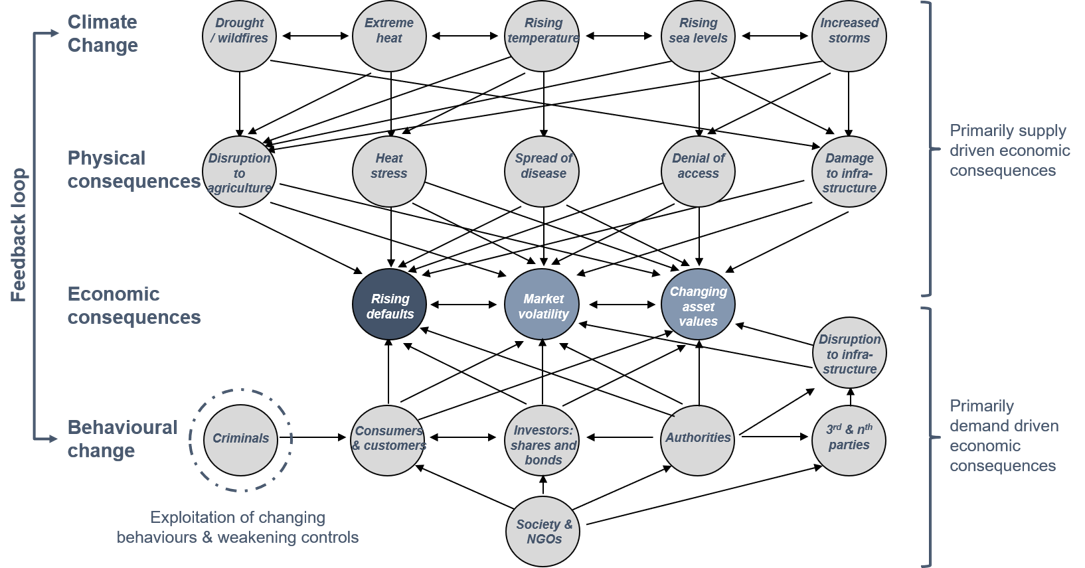
Additionally, physical and transition risks can also combine, for example, in 2021, one of the contributing factors to a 10-year high in tin prices was a drought in China’s Yunnan province which led to shortages of renewable hydroelectric power, forcing local tin smelters to halt temporarily production.4
Climate change scenarios: From early action to no additional action
There are a number of scenarios defined for climate change, with differing economic and environmental outcomes. Whilst the early action scenario is relatively benign economically and environmentally, the late action scenario involves the world abruptly decarbonising, in the 2030s, in response to demonstrable climate change, resulting in a very sharp economic shock, on a par with the global financial & Euro crises (see Figure 2).
Figure 2: Comparison of historical shocks vs climate change projections for two US economic metrics5
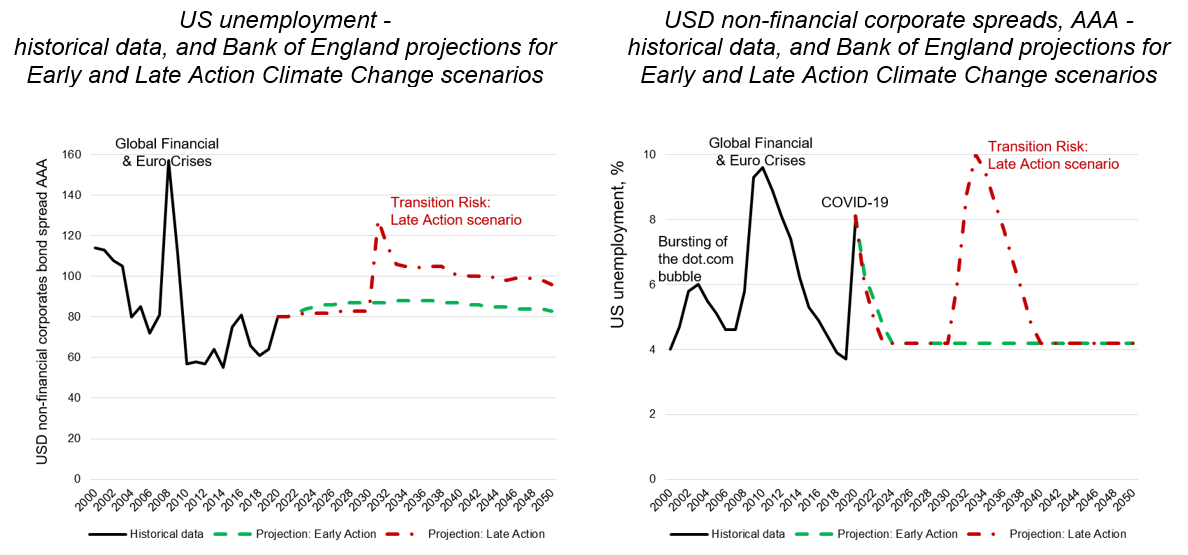
Beyond that, the “no additional action” scenario (2040s) results in both an unstable economy and environment, as “Once physical risks begin to manifest in a systemic way it may already be too late to reverse many effects through emissions reductions” and “their impact will likely be correlated, non-linear, irreversible and subject to tipping points”.6
Historical sensitivity: Operational risk losses via economic shocks
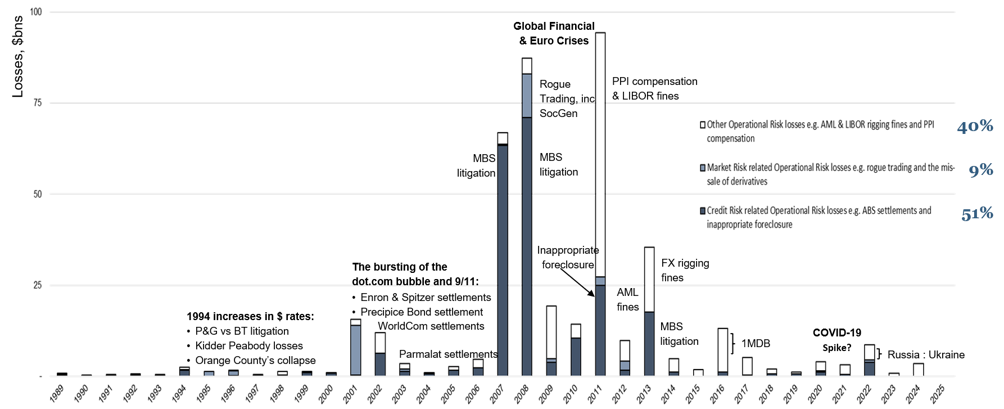
This level of economic disruption is important as historically operational risk has been extremely sensitive to rapid and significant economic change (see Figure 3). This reflects that economic shocks can drive operational risk losses by:
- influencing the occurrence of new events;
- and / or triggering the detection of historical and ongoing events;
- and / or exacerbating the severity of loss events.
Misconduct can play a key role in this process by converting market and credit risks into operational risk via the granting of real options, which give stakeholders the “right, but not the obligation, to seek redress”. Examples of this include the misrepresentation or the mis-sale of hedging or investment products and securities. These real options are triggered by the stakeholders suffering financial loss, as a consequence of rapid changes in financial indices and / or credit defaults. Stakeholders, however, will only seek redress, if their losses are sufficiently material, hence the economic shock has to be sufficiently significant. The importance of real options is highlighted in Figure 3 through the analysis of the underlying nature of the losses, i.e. ~51% relate to credit risk and 9% relate to market risk.
Figure 3: Analysis of large losses (≥$0.1bn) suffered by 32 current and former G-SIBs over 37 years7
Behavioural changes and economic retrenchment
In addition to litigation regarding hedging products, investments, and securities, as noted earlier, changes to the occurrence of operational risk events variously arise from a mixture of economics and behavioural change. For example, in the run-up to the global financial crisis, customers and banks began to retrench, e.g. new mortgage approvals for UK house purchases declined in each quarter of 2007, prior to the UK entering recession. This reduction in business activity may explain why “…the frequency of losses [EDPM and external fraud] in the early-crisis period [H2 2006 to H2 2007] was similar or slightly lower than pre-crisis losses” for ORX members.8,9 Subsequently, mounting financial pressures may lead to some, previously law abiding, customers resorting to fraud to stave-off financial collapse.10 Rising customer defaults may also lead to claims for compensation for failing to treat customers fairly that are in financial difficulties, similar to the settlements in the US for inappropriate foreclosure in the aftermath of the global financial crisis.
Criminals may also respond to changing circumstances to exploit new opportunities, e.g. the global financial & Euro crises coincided with a rise in account take-over frauds, but a decline in application frauds, as banks retrenched their lending.11 Rising supplier defaults may also lead to operational disruption and losses, e.g. higher electricity prices, following Russia’s invasion of Ukraine, contributed to SunGard UK, a datacentre operator, entering administration in March 2022. Its customers reportedly included JPMorgan Chase.12
Mapping operational risk sensitivity
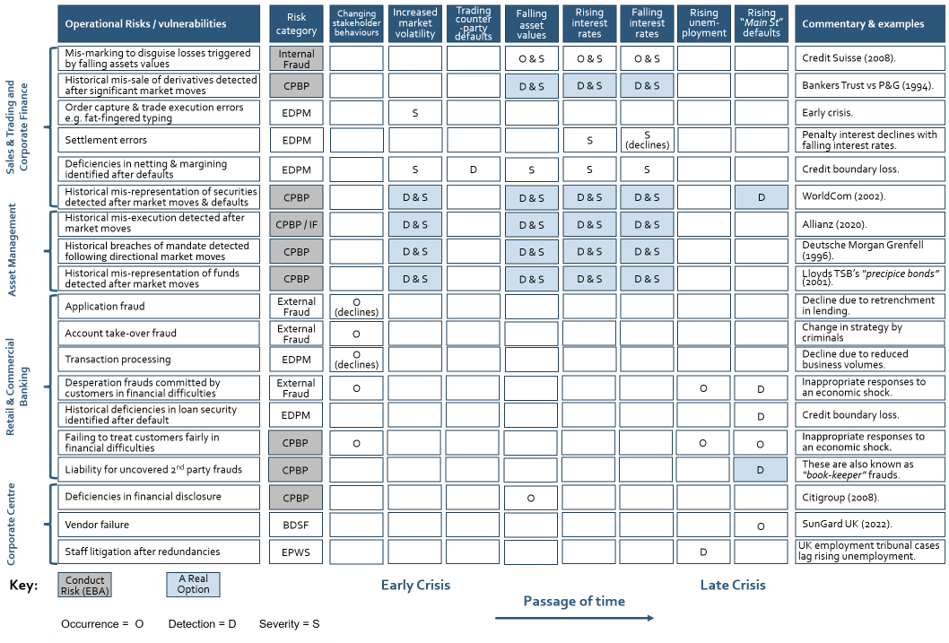
Consequently, firms should map the sensitivity of their operational risks for their different business lines to sharp changes in economic metrics and changes in stakeholder behaviours. The “lack of relevant historical experience”,13 can be compensated for, in part, by drawing parallels with past economic crises, e.g. the bursting of the dot.com bubble and the global financial & Euro crises (Table 1) and events, such as the UK’s “Great Drought” of 1976, COVID-19, El Niño, and Hurricane Sandy.
Table 1: Mapping the sensitivity of operational risks to economic metrics and behavioural changes14
Conclusions
The world’s climate is demonstrably changing – 2024 was the warmest year on record, and 2025 was the 2nd warmest, and 2026 and 2027 are likely to set new records due to an "unprecedented” El Niño cycle.15 Whilst the focus for operational risk has often been on these physical risks and their impact on operational resilience, it is the economic consequences that could prove to be most financially impactful to banks. Understanding how rapid and significant changes to economic metrics, and associated behavioural changes of key stakeholders, influence the occurrence, detection, and severity of different operational risks is key to their effective management.
Tackle the defining challenges facing today’s risk leaders at RiskMinds this November.

References:
- Basel Committee on Banking Supervision, (April 2021) “Climate-related financial risks – measurement methodologies”.
- France-Presse, A. The Guardian, (21st August 2026) “Panama Canal to reduce shipping as El Niño strikes vital route”.
- Adapted from Grimwade, M., (2021), “Ten Laws of Operational Risk”, Wiley & Sons.
- The Financial Times, (29th May 2021)“Tin prices hit 10-year high amid shift to homeworking and supply disruptions”.
- Bank of England, (2021) “Climate Biennial Exploratory Scenario (CBES)”.
- PRA, (December 2025) “Enhancing banks’ and insurers’ approaches to managing climate-related risks”, SS5/25.
- Adapted from Grimwade, M., (2021) “Ten Laws of Operational Risk”, Wiley & Sons.
- Cope, E., and Carrivick, L., (2013) “Effects of the Financial Crisis on Banking Operational Risk Losses”, Journal of Operational Risk Vol. 8, No. 3.
- This contrasts with the decline in mortgage applications at the beginning of the COVID-19 pandemic, i.e. which coincided with a sharp decline in UK GDP.
- BDO’s (2018) “FraudTrack Survey” report highlights the importance of either “Greed” or “Need” as motivations for fraud.
- Grimwade, M., (2016) “Managing Operational Risk: New Insights and Lessons Learnt”, RiskBooks.
- Moss, S., (30th March 2022) “SunGard UK goes into administration, blames it on the energy crisis”, Data Centre Dynamics.
- EBA, (8th January 2025) “Guidelines on the management of environmental, social and governance (ESG) risks”, EBA 2025/01.
- Adapted from Grimwade, M., (2025) “Operational Risk stress testing: Challenges and approaches”, Journal of Risk Management in Financial Institutions, Vol. 18, No. 2.
- The UK’s Meteorological Office, (21st August 2026) “An unprecedented El Niño and its implications for the weather forecast”.
About Michael Grimwade
He has worked on Operational Risk management for over 30 years and has been Head of Operational Risk for ICBC Standard Bank and International Head of Operational Risk at MUFG Securities. Michael has also held senior Operational Risk management roles at RBS and Lloyds TSB, and he has been a Board Member of both the Securities Industry BCM Group and the Institute of Operational Risk. Michael has written a number of peer-reviewed papers on Operational & Reputational Risks covering: quantifying emerging risks; modelling capital; stress testing; and Climate Change. He received an award in 2014 from the Institute of Operational Risk for his contribution to the profession. Michael has had two books published: “Managing Operational Risk” in 2016, and “Ten Laws of Operational Risk” in 2021. He is now focusing on interim management and consulting assignments, and also delivering training to Operational Risk professionals.