What can operational risk managers learn from aviation?


Boasting with a 99.99999% probability of safely walking off a commercial flight in Europe, the aviation industry achieved operational excellence not seen in banking. Inspired by conversations with aviation professionals, Konrad Kompa, Financial Risk Management Director at mBank SA, shares key lessons in aviation safety and what risk managers could apply.
Last year, one of my teams had an operational risk incident that was both frustrating and humbling. A simple human error could have resulted in a material financial loss. Fortunately, it did not. What bothered me was that it happened in a strong operation with a resilient control framework, and the mistake was made not by a weak performer, but by an experienced A-player: exactly the kind of person you would trust with a critical process. How could we have prevented it? What additional check should we introduce?
The weekend after the incident I was visiting a friend who happens to be a pilot. While waiting for coffee, I noticed a pile of books on aviation safety on his desk. I picked one up. A long conversation about accidents, human error and incident investigation followed. That conversation started a journey into aviation safety literature, accident reports and discussions with aviation professionals. This article is about what I found: how did aviation become so good at operational resilience, and what could bank risk managers borrow from it?
Key takeaways for financial risk managers from aviation safety
- Build redundancy, not single points of failure: Aviation's Swiss Cheese model layers multiple imperfect controls so an accident only happens when several weaknesses align at once. Critical processes should never rely on one safeguard alone.
- Adopt a just culture, not a blame culture: Honest mistakes should be distinguished from deliberate rule-breaking or negligence. Punishing honest errors discourages reporting, which removes the very information needed to improve safety and controls.
- Clarify ownership before incidents occur: Responsibility should be assigned by area or function, not just by predefined procedure, so unusual or new issues do not fall through the cracks between departments.
- Strengthen communication and challenge culture: Teams need the ability to speak up and challenge senior decisions; aviation incidents demonstrated hierarchy silencing doubts at Tenerife but open cooperation saving lives at Sioux City.
- Preserve human judgment alongside automation: As seen in the Air France 447 case, growing reliance on automation and AI must not erode core human skills needed when systems fail or conditions turn unfamiliar.
What’s behind the aviation industry’s low incident rate?
Fatal accidents in commercial aviation are extraordinarily rare. That cannot be explained by flying hundreds of people inside a pressurised metal aircraft, typically 10 to 11 kilometres above sea level, being inherently safe. It is the result of decades spent learning how to operate a complex system in which humans make mistakes, technology fails and circumstances surprise. In banking, 99.9% can sound like a high standard. But it still means one failure in every thousand events. Aviation operates several orders of magnitude beyond that: the probability of safely walking off a commercial flight in Europe is around 99.99999%. Comparing the two is like comparing 1 centimetre with the height of London’s Big Ben.
Much of aviation’s remarkable safety performance is an engineering achievement. Aircraft are designed on the assumption that individual components will eventually fail. Critical systems are built with redundancy and fault tolerance, so that when one component fails, another can take over or the system can continue operating with reduced capability. Engineers call this ‘graceful degradation’: performance deteriorates progressively rather than catastrophically. The machine is designed to absorb individual failures rather than amplify them. There is a great deal for banks to learn from these principles when designing critical IT systems. But the design of the aircraft alone does not deliver 99.99999% safety.
Processes play just as important a role. Aviation is highly standardised internationally: wherever possible, the same rules, terminology and ways of working apply across borders, reducing complexity and the risk of error. Regulations also evolve when experience shows that a rule no longer makes sense. This matters because nonsensical rules invite workarounds, and once a precedent for bypassing the rules is established, far more important rules may follow.
Safeguarding practices: Banking vs aviation
In banking, the Basel Committee and European Banking Authority define global and European standards respectively, yet local implementations can still vary significantly. Complexity also grew to enormous levels. Standardisation in aviation extends deep into everyday operations. Checklists reduce the risk of unintentionally omitting an important step, while responsibilities are assigned in a way to avoid ambiguity.
One lesson that stayed with me from my conversation with an aviation professional was the importance of assigning responsibility for particular areas of operation: you might not have a predefined procedure for a wild boar on the apron, but it is clear who is responsible for the apron, whatever happens there. In banking, unusual or new issues can fall through the cracks precisely because they do not fit into anyone’s predefined responsibility. Next time three departments are debating who owns an issue, don’t think who owns the boar but who’s responsible for the apron.
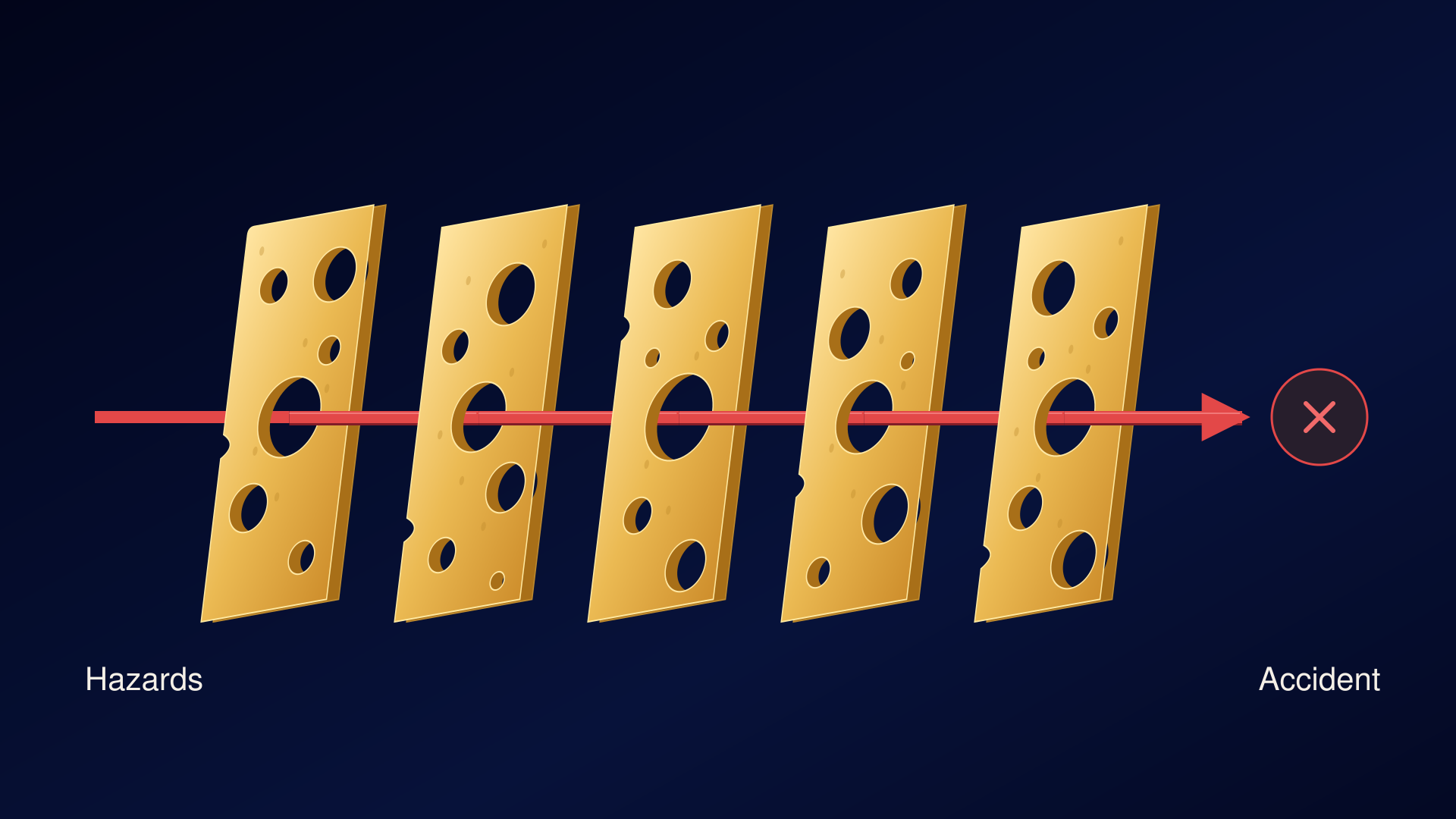
No individual safeguard is assumed to be perfect. The well-known Swiss cheese model imagines safety as multiple layers of controls, each with its own weaknesses. An accident occurs when the holes happen to align. Where something is really critical, it helps to add a few extra slices, preferably of different kinds of cheese. Aviation also places great emphasis on learning from accidents, incidents and near misses. A near miss is not merely a lucky escape. It is an opportunity to discover where the holes nearly aligned before they do so again. When the holes do align, aviation tries to ensure that the resulting tragedy changes the system. Two famous accidents show how this learning works.
Aviation incidents that changed the industry
At Tenerife in 1977, two Boeing 747s, operated by KLM and Pan Am, collided on the runway in dense fog, killing 583 people. Several factors combined: congestion, poor visibility and ambiguous radio communication. Critically, the KLM captain began a take-off without a take-off clearance. Other crew members expressed doubts, but these did not result in the take-off being stopped. One factor often discussed in analyses of the accident is the authority gradient in the cockpit and the difficulty of effectively challenging a senior captain. Tenerife accelerated aviation’s focus on communication, teamwork and the ability to challenge authority effectively.
United Airlines (UA) Flight 232 in 1989 showed almost the mirror image. An engine failure caused the loss of all three hydraulic systems leaving the crew without conventional flight controls, an event considered so improbable that there was no procedure for it. They improvised, using engine thrust to achieve limited control. The crew also involved an off-duty pilot instructor travelling as a passenger to help them. The aircraft crashed during the attempted landing at Sioux City, but 184 of the 296 people aboard survived. The crew’s ability to adapt, cooperate and improvise became an additional layer of defence, which helped to save 184 lives.
The contrast is striking: at Tenerife, the human element became one of the weakest links in the system; at Sioux City, it became perhaps its strongest. That takes us to arguably the most interesting aspect of aviation safety…
The human element: Just culture and crew resource management
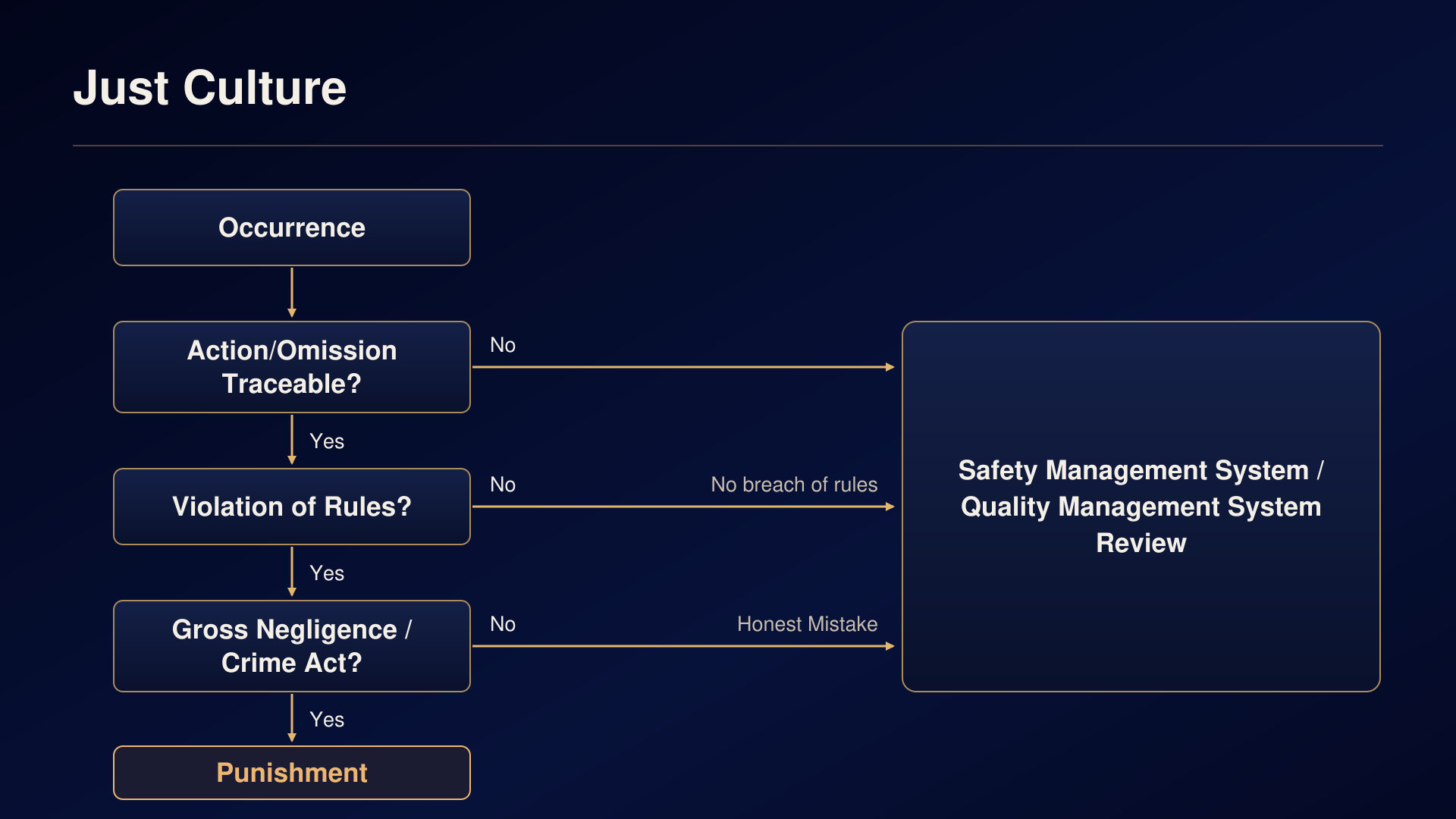
The human element remains integral to aviation, so let’s look at how the industry embraces and manages it. One of its most important concepts is the just culture. The starting point is simple: genuine human errors will happen, and some will matter. The objective is to handle them effectively and, crucially, learn from them. If people believe that an honest mistake may be punished, they are less likely to report mistakes and near misses. The organisation then loses precisely the information it needs to improve safety. But just culture does not mean ‘no blame’. It distinguishes honest mistakes from deliberate rule-breaking, gross negligence or reckless behaviour. The objective is neither a blame culture nor a blame-free culture, but a learning culture with clear accountability. However, before you start judging an individual, firstly establish whether any rules were actually broken. If not, this might be a process weakness. Where governance is lax, mistakes and omissions are bound to occur sooner or later.
The second concept is crew resource management (CRM). Tenerife demonstrated why technical competence alone is not enough: highly experienced professionals can still make bad decisions, and hierarchy can prevent others from challenging them. CRM is therefore integral to pilot training, including recurrent training and simulator exercises. Crews practise communication, situational awareness, workload management, decision-making, leadership and effective challenge. A junior crew member must be able to question a captain when something does not look right, while the captain must create an environment in which such challenge is expected rather than merely tolerated. The best expertise in the cockpit has limited value if hierarchy prevents it from being heard or used. Both the captain of UA 232, as well as the National Transportation Safety Board, emphasised importance of CRM training in the crew’s ability to manage an emergency that no procedure or checklist had anticipated.
Lessons in aviation risk management for bankers
And perhaps that is where aviation became most interesting to me as a risk manager. When I started this journey, trying to understand what banking risk management could learn from aviation, I expected to end up studying engineering, controls, procedures and checklists. I did not expect to end up studying leadership, cooperation, speaking up, accountability and one of my favourite subjects: what we in banking call the risk culture. Perhaps that should not have been surprising. Systems and controls matter enormously, but ultimately their effectiveness depends on the behaviours and attitudes of the people operating them, whether they are flying a plane or managing a bank.
So when the next incident happens:
- establish the facts,
- analyse how the holes in the Swiss cheese aligned,
- clarify ownership where it was ambiguous
- distinguish an honest mistake from reckless behaviour
And before the incident happens, make sure people have the right conditions to speak up and challenge. Good risk culture means that risks are more likely to be challenged before they become incidents, and incidents more likely to become lessons rather than repeated mistakes.
Looking ahead to an agentic AI environment, the 2009 Air France 447 accident offers another important lesson: automation should not allow underlying human skills to disappear. After unreliable airspeed indications caused the autopilot to disconnect, the crew made inappropriate control inputs and failed to recognise and recover from the resulting stall. Modern aircraft rely heavily on automation, but pilots still need to retain the skills to act effectively when automation is unavailable or conditions become unfamiliar.
Be part of the largest gathering of risk leaders anywhere – RiskMinds kicks off 16 November 2026.